The Cabin in the Woods (2012)
A razor-sharp genre deconstruction that hides its teeth behind beer cans, forest shadows, and an apocalyptic sense of humor.
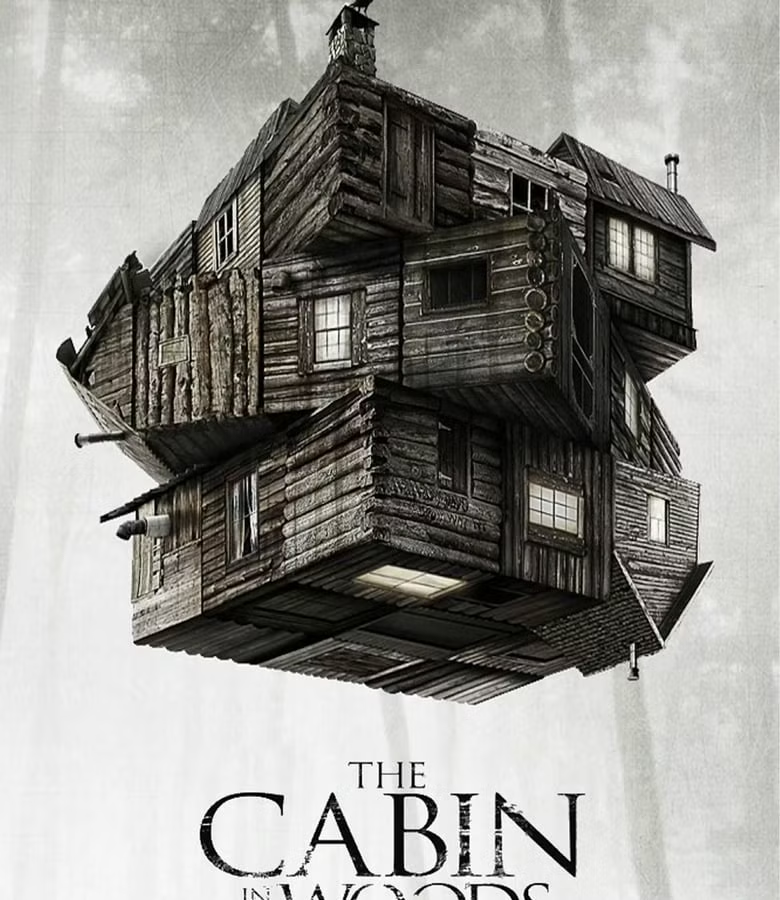
At a Glance
- Director: Drew Goddard
- Cast: Kristen Connolly, Chris Hemsworth, Anna Hutchison, Fran Kranz, Jesse Williams, Richard Jenkins, Bradley Whitford
- Subgenres: Comedy Horror, Sci-Fi Horror, Slasher Horror, Cosmic Horror, Social Horror
- Tone & Style: Ironic, Gory, Fast-Paced, Self-Aware, Effects-Driven
- Best For: Horror fans who know the rules well enough to enjoy watching them dismantled in real time.
- Not ideal for: Viewers looking for a straight-faced, traditional cabin slasher with no genre commentary.
- Country of production: United States
- Language: English
Release Date: April 13, 2012 (U.S. theatrical)
Runtime: 95 minutes
Rating: R for bloody violence and gore, language and brief drug use.
Rotten Tomatoes: Critics 92% • Audience 74%
Metacritic: Critics 72 • User 7.4
Letterboxd: 3.4 / 5
EncoreCraft Score: 86 / 100
Where to Watch: View current streaming availability on JustWatch
Official Trailer
EncoreCraft Breakdown (0–10)
- Rewatch Value: 9 / 10
- Scare Factor: 7 / 10
- Performances: 8 / 10
- Violence and Disturbance: 8 / 10
- Pacing: 9 / 10

Synopsis
The drive to the cabin feels ordinary at first, tires humming over pavement while jokes bounce between friends and the forest thickens on both sides of the road. Once they arrive, the house greets them with the kind of unease that’s easy to ignore at first: a cellar door that creaks too loudly, dust hanging in the air, objects arranged as if they want to be noticed. Laughter fills the rooms, but it echoes strangely, as though the walls are listening. Small decisions begin to feel heavier than they should, each choice nudged by something unseen. What was meant to be a careless weekend quietly reveals itself as a space designed for consequences.
Beneath the surface of beer cans and flirtation, an invisible structure is already in place. The friends move through the cabin believing they are acting freely, even as their behavior aligns with expectations they never agreed to follow. The woods press in closer at night, and the sense of isolation sharpens with every passing hour. What unfolds is not simply a violent encounter, but the slow realization that the cabin is less a destination than a stage, and that the script has been waiting for performers.

Spoiler-Free Review
Fluorescent lights and beige walls open the film, the buzz of an office space settling into your ears before a single scream is heard. That choice quietly reframes everything that follows, because when the story shifts to the cabin, the feeling of surveillance never disappears. Each familiar horror beat lands with a faint delay, as if it has already been approved somewhere else. The result is a persistent discomfort that has less to do with surprise and more to do with inevitability. You don’t just watch characters walk into danger; you sense that the danger has been patiently arranged.
Inside the cabin, the film plays with expectations by exaggerating them just enough to feel off. Dialogue sounds slightly pushed, reactions linger a second too long, and the environment seems to respond immediately to poor decisions. These subtle distortions create tension without relying solely on jump scares. Fear comes from recognizing patterns rather than being shocked by them. The audience is invited to feel clever for noticing, then uneasy for understanding what that recognition implies.
The performances reinforce this balance between satire and sincerity. Fran Kranz’s Marty moves through the film with constant physical unease, his wary glances and restless posture signaling resistance before the plot confirms it. Other characters lean more heavily into archetype, but never so far that they feel disposable. Bloodshed arrives suddenly and messily, splattering against dirt and wood without romantic framing. The film’s 86 EncoreCraft Score reflects how effectively it blends commentary with momentum, delivering a horror experience that’s as engaging as it is confrontational.
Craft Notes & Background (Non-Spoiler)
- The screenplay was written by Joss Whedon and Drew Goddard before either had directed a feature film.
- Although released in 2012, the film was shot in 2009 and delayed due to studio distribution issues.
- The cabin interior was constructed on a soundstage, while exterior forest scenes were filmed in British Columbia.
- Many of the creature designs were realized using practical effects and full-body suits rather than CGI.
- The film deliberately casts its characters to align with classic horror archetypes before gradually undermining them.
⚠️ ⚠️ SPOILERS BELOW ⚠️ ⚠️
The rest of this review discusses the full plot and ending.
⚠️ ⚠️ SPOILERS BELOW ⚠️ ⚠️
Full Plot Recap (Spoilers)
Once the group settles in, the illusion of choice begins to fracture. Hidden technicians manipulate temperature, lighting, and even brain chemistry, subtly steering behavior while tracking progress on glowing monitors. When the friends descend into the cellar, their curiosity is not spontaneous but prompted, and the moment a cursed object is handled, the ritual locks into place. Violence follows quickly, the forest becoming a killing ground where screams are swallowed by trees and blood stains the dirt. Each death aligns perfectly with an assigned role, fulfilling requirements that have nothing to do with personal guilt or morality.
Between attacks, the film cuts to the control room, where operators react with cheers, frustration, and office banter. Buttons are pressed, bets are settled, and mistakes are reprimanded, all while lives are extinguished aboveground. This cross-cutting drains the murders of individual meaning, transforming them into procedural steps. The horror shifts from fear of death to dread of purpose, as it becomes clear that suffering is not incidental but necessary. Survival, in this system, is a problem to be corrected.
Marty’s survival disrupts the ritual’s clean efficiency. Presumed dead, he reemerges bruised, limping, and suspicious, uncovering the scope of the operation beneath the cabin. Alongside Dana, he descends into the facility, passing cages filled with monsters that rattle, snarl, and scrape against metal bars. Their movement through these corridors triggers chaos, releasing years of suppressed nightmares in a violent cascade. Control collapses as blood sprays across sterile floors and alarms wail.
At the heart of the facility, the truth is revealed. The ritual exists to appease ancient beings whose awakening would destroy the world. Dana is offered the chance to complete the sacrifice and preserve humanity, standing alone as the final survivor. The choice hangs in silence, broken only by distant rumbling and falling debris. Marty intervenes, refusing to endorse a system built on enforced death. The film ends with the collapse of the ritual and the implied end of the world, not as spectacle, but as consequence.
Spoiler Analysis
Fear in The Cabin in the Woods doesn’t explode; it erodes. Characters make small compromises first, accepting nudges and rationalizing discomfort until resistance feels pointless. The technicians mirror this process from the opposite side of the glass. Leaning on railings and sipping coffee, they follow procedure because deviation feels more dangerous than cruelty. The film suggests that under sustained pressure, behavior doesn’t collapse into chaos but settles into habit.
Formally, the film scares by splitting attention. Every tense moment in the woods is undercut by a cut to control panels, surveillance screens, and casual commentary. This rhythm denies catharsis, refusing to let the audience fully immerse in either fear or relief. Monsters are terrifying, but the mechanisms releasing them are clean, well-lit, and disturbingly calm. Horror becomes something engineered rather than unleashed.
The ending reframes the entire experience. When the world is allowed to end, the moment is quiet, almost understated, marked by collapsing stone and a hand rising from the earth. There is no triumph in survival and no grandeur in extinction. The film refuses to reward obedience or punish defiance in familiar ways. Instead, it leaves the audience with the weight of the question it has been asking all along: if horror depends on ritualized suffering, who is it really serving, and why should it continue at all?
Hidden Craft & Story Secrets (Spoilers)
- The elevator massacre sequence combined dozens of practical creature effects operating simultaneously.
- Each monster corresponds to a different horror subgenre that could have satisfied the ritual.
- The Ancient Ones were intentionally designed to avoid tying them to a single mythology.