Halloween Ends (2022)
Messy, daring, and strangely mournful. Less a victory lap than a sideways stumble into the franchise’s own shadow.

At a Glance
- Director: David Gordon Green
- Cast: Jamie Lee Curtis, Andi Matichak, James Jude Courtney, Rohan Campbell, Will Patton
- Subgenres: Slasher Horror, Psychological Horror, Social Horror, Thriller-Adjacent Horror
- Tone & Style: Bleak, Character-Driven, Gritty, Uneasy, Occasional Slow Burn
- Best For: Fans of franchise entries that take thematic risks and lean into bleak character study
- Not ideal for: Viewers expecting a clean, crowd-pleasing slasher finale
- Country of production: United States
- Language: English
Release Date: October 14, 2022 (U.S. theatrical)
Runtime: 111 minutes
Rating: R (for bloody horror violence and gore, language throughout, and some sexual references)
Rotten Tomatoes: Critics 40% • Audience 57%
Metacritic: Critics 47 • User 4.5
Letterboxd: 2.1
EncoreCraft Score: 53 / 100
Where to Watch: View current streaming availability on JustWatch
Official Trailer
EncoreCraft Breakdown (0–10)
- Rewatch Value: 5 / 10
- Scare Factor: 6 / 10
- Performances: 8 / 10
- Violence and Disturbance: 7 / 10
- Pacing: 5 / 10

Synopsis
Four years after the last Halloween bloodbath, Haddonfield appears calmer, but the stillness feels strained rather than peaceful. Porch lights hum against empty streets, windows glow late into the night, and conversations end just a little too quickly. Michael Myers has vanished, yet his absence has not brought relief so much as a lingering sense of vigilance. Fear no longer has a single face, and the town seems unsure where to direct it.
As a troubled young man becomes entangled with Laurie Strode’s family, old wounds reopen in unexpected ways. The film reframes evil not as a masked figure stalking the shadows, but as something that spreads through shame, rumor, and unresolved anger. What follows is not a traditional chase, but a slow corrosion of judgment that pulls multiple lives toward violence.
Spoiler-Free Review
The opening stretch of Halloween Ends signals immediately that this is not a typical slasher rhythm. Unease comes from awkward silences, lingering stares, and the quiet hostility embedded in everyday exchanges. Fear manifests socially before it ever becomes physical, and the film asks the audience to sit with that discomfort. It is a deliberate, often challenging approach that prioritizes atmosphere over immediate thrills.
Jamie Lee Curtis remains the emotional anchor, grounding the film with a performance built on restraint rather than spectacle. Her Laurie is visibly experimenting with peace, testing whether normal routines can exist alongside decades of trauma. Simple domestic moments carry tension, coffee cups clink too loudly, and pauses linger in conversation. Even when the narrative strains, Curtis sells the weight beneath the calm.
Where the film falters is in balancing its thematic ambitions with its obligations as a franchise finale. Long character-focused detours clash with the expectation of ritual confrontation, and the eventual pivot to slasher mechanics can feel abrupt. The result is a movie that resists being what it is supposed to be, even when it finally has to comply. That friction is either its boldest strength or its most frustrating flaw, depending on the viewer.
Craft Notes & Background (Non-Spoiler)
- Halloween Ends premiered at Beyond Fest in Los Angeles on October 11, 2022.
- The film received a simultaneous theatrical and Peacock release in the United States.
- It was directed by David Gordon Green and co-written with Danny McBride, Paul Brad Logan, and Chris Bernier.
- John Carpenter returned to score the film alongside Cody Carpenter and Daniel Davies.
- Principal photography took place in Georgia, including the Savannah area.
- The production used the working title Cave Dweller.
⚠️ ⚠️ SPOILERS BELOW ⚠️ ⚠️
The rest of this review discusses the full plot and ending.
⚠️ ⚠️ SPOILERS BELOW ⚠️ ⚠️
Full Plot Recap (Spoilers)
The film opens with a sudden and devastating accident involving a young babysitter and a child, staged with harsh immediacy. The sound of impact, the stunned silence that follows, and the crowd that gathers to judge him define how quickly Haddonfield turns tragedy into condemnation. From that moment forward, the town treats him as a symbol of its unresolved fear.
Years later, he drifts through the margins of the community, forming a tentative relationship with Laurie’s granddaughter. Hostility follows him everywhere, escalating from whispered accusations to outright violence. His encounter with Michael Myers in the city’s forgotten spaces becomes a grim turning point, drawing him into a cycle of imitation and brutality.
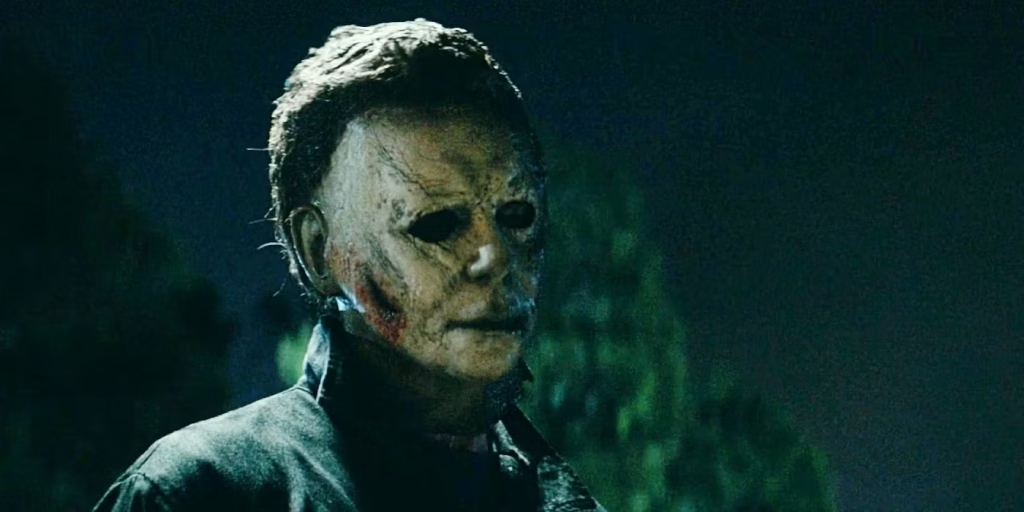
As murders mount, Michael’s presence remains strangely muted, appearing in brief, brutal flashes. The final act shifts toward resolution, culminating in Michael’s public destruction. Laurie survives, but the victory feels subdued, leaving behind a town that is quieter, not healed.
Spoiler Analysis
Fear in Halloween Ends functions as a social toxin rather than a sudden shock. Characters justify cruelty through caution, allowing suspicion to replace empathy. Raised voices, hurried footsteps, and clenched hands show how quickly moral clarity erodes under pressure. The film argues that prolonged fear does not create monsters so much as enable them.
Formally, the movie withholds the pleasures of traditional slasher pacing. Long static shots, dim lighting, and scenes that end without release create sustained frustration. When violence breaks through, it is loud and abrupt, denying catharsis. The horror lies in the disruption rather than the spectacle.
The ending strips Michael Myers of mythic stature, reducing him to something that must be dealt with collectively and unceremoniously. His destruction suggests that evil does not end through symbolism, but through exhaustion and agreement. Even then, the damage remains embedded in behavior. The film closes on the unsettling idea that what replaces the monster may be harder to recognize than the mask ever was.