Hereditary (2018)
Annihilating family grief that quietly tilts into occult nightmare, Hereditary feels like watching a curse tighten around a house in slow motion.

At a Glance
- Director: Ari Aster
- Cast: Toni Collette, Alex Wolff, Milly Shapiro, Ann Dowd, Gabriel Byrne
- Subgenres: Supernatural Horror, Psychological Horror, Occult Horror, Demonic Horror, Folk Horror
- Tone & Style: Atmospheric, Slow Burn, Character-Driven, Visually Stylized, Claustrophobic, Bleak/Despairing, Psychological Tone
- Best For: Fans of slow-burn, emotionally devastating horror that prioritizes atmosphere, grief, and performance-driven dread.
- Not ideal for: Viewers who prefer fast pacing, clear answers, frequent jump scares, or lighter horror without sustained emotional weight.
- Country of production: United States
- Language: English
Runtime: 127 minutes
Rating: R – for disturbing violence and terror, graphic images, brief sexual content, and language
Rotten Tomatoes: Critics 90% • Audience 72%
Metacritic: Critics 87 • User 7.5
Letterboxd: 3.9
EncoreCraft Score: 94 / 100
Where to Watch: View current streaming availability on JustWatch
Official Trailer
EncoreCraft Breakdown (0–10)
- Rewatch Value: 9 / 10
- Scare Factor: 9.5 / 10
- Performances: 10 / 10
- Violence and Disturbance: 8.5 / 10
- Pacing: 8.5 / 10

Synopsis
Annie Graham is a miniature artist living in a secluded house in the woods with her husband Steve and their two children, shy Charlie and anxious teen Peter. When Annie’s secretive mother dies, the family tries to move through the motions of grief while quietly acknowledging that this woman left behind more damage than warmth. Annie’s eulogy is full of uneasy caveats, and the strangers who show up to the funeral feel less like mourners and more like people attending a ceremony she never understood.
As Annie’s grief deepens, strange things begin to seep into the family’s daily life. Charlie seems fixated on death and makes ominous little sculptures. Peter struggles with guilt and teen detachment. Annie starts to see patterns in her mother’s belongings that suggest a hidden spiritual life she was never fully told about. A horrific accident fractures the family even further, and what begins as a domestic tragedy slowly starts to feel like a design, as if someone has arranged the Grahams on a table and is nudging them toward a fate they cannot see.
Spoiler-Free Review
Hereditary arrives with the reputation of being one of the defining “elevated horror” films of the last decade, but that label is a bit misleading. What Ari Aster actually delivers is a brutal family drama that refuses to comfort anyone, then gradually lets something much older and stranger bleed through the wallpaper. The horror lands so hard precisely because it starts from feelings that are painfully recognizable: complicated grief, resentment between parents and children, and the fear that you have passed something poisonous on to the people you love most.
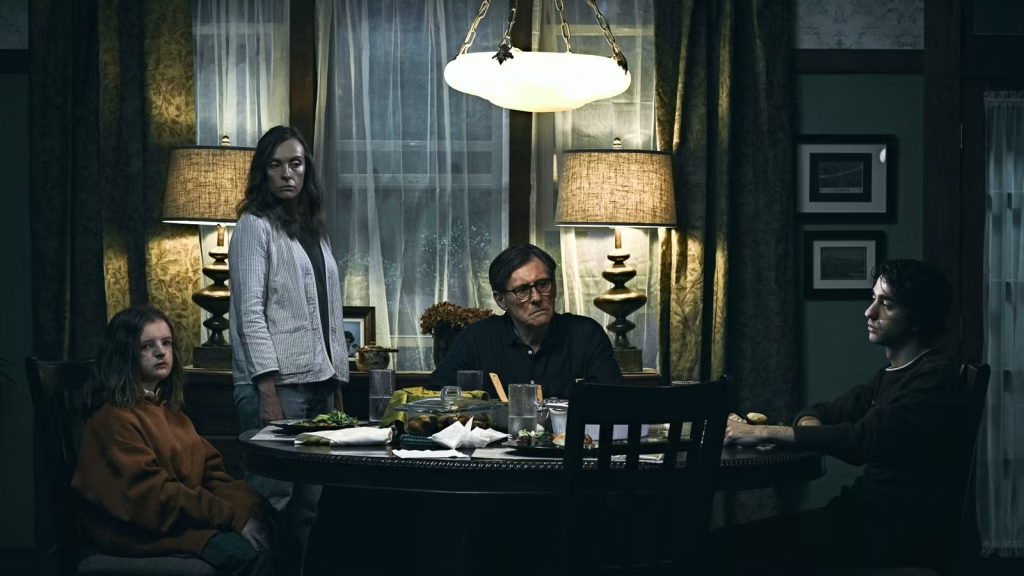
Toni Collette’s performance as Annie is the screaming heart of the film. She plays grief not as quiet dignity but as something jagged and humiliating that keeps spilling out at the worst possible moments. Her dinner table monologue has become the famous clip, but it is the smaller choices that really sting: the way her voice trembles when she insists she is “fine,” the dazed way she drifts through the house after tragedy, the way affection and blame are constantly tangled when she looks at her son. Alex Wolff matches her with a raw, twitchy performance as Peter, a teenager trying to numb himself while his brain and body are clearly stuck in permanent fight-or-flight.
Visually, Hereditary is obsessed with control. The film opens on a dollhouse and glides into a “real” room in one unbroken move, and that trick keeps echoing throughout. Sets are lit and framed like miniature dioramas, with the house often shown front and center as if we are peering at it on a shelf. Rooms are deep and boxed in, doors line up in straight corridors, and characters are often held in wide shots that make them look like pieces in someone else’s display. It is a simple but unnerving choice: the more you notice it, the more you feel that the Grahams are being arranged, not filmed.
Sound design and Colin Stetson’s score do just as much damage as the images. The music leans on low, scraping tones, strange vocal textures, and sudden swells that feel less like melody and more like something breathing in the walls. Even in quiet scenes, there is often a faint rumble underneath, as if the film is keeping a sustained note of panic going while the characters are trying to have normal conversations. The occasional harsh sound cue is used sparingly, which makes it hurt when it arrives.
The pacing is unmistakably slow burn, which will be a plus for some viewers and a deal-breaker for others. Aster spends long stretches letting us sit in arguments, awkward support group meetings, and silent meals where no one can quite say the most honest thing out loud. When the horror does surge, it feels like the release of pressure that has been building in every scene. That shift from simmering anxiety to full nightmare is one reason the film earns such a high scare score: even moments without monsters or apparitions are hard to sit through, because the emotional stakes are so high.
Underneath the supernatural elements, Hereditary keeps circling ideas about what we inherit. There are hints of mental illness, addiction, and family secrets threaded throughout, and for much of the movie it is possible to read what is happening as the result of trauma rather than literal demons. The film never fully lets you off the hook with a single explanation. Instead, it presents a family that feels doomed both by outside forces and by patterns of behavior passed down over generations, and that double reading is part of what makes the story so unsettling.
As a horror experience for modern audiences, Hereditary is intense, meticulous, and deliberately punishing. Casual viewers expecting a roller-coaster of jump scares may find it slow and emotionally exhausting. For horror fans and anyone who likes their genre mixed with real emotional stakes, though, it is the kind of film that crawls inside your head and rearranges the furniture. The craft, performances, and ambition justify an EncoreCraft Score in the mid-90s: it is not just scary in the moment, it lingers in how you think about family, fate, and the idea that some stories were always going to end badly.
Craft Notes & Background (Non-Spoiler)
- Hereditary is Ari Aster’s feature directorial debut, expanding on the family-tragedy themes he explored in his earlier short films.
- The movie was conceived as a family drama first and a horror film second, which is why so much of the runtime is devoted to arguments, guilt, and grief before the supernatural elements fully take over.
- The film premiered at the Sundance Film Festival in January 2018 before its wide U.S. theatrical release that June, a path that helped build early “this is the scariest film in years” buzz.
- Most of the interior house scenes were shot on custom-built sets on a soundstage, designed so the camera could move walls and ceilings like a dollhouse and maintain that miniature, controlled feeling.
- The miniature dioramas that Annie creates are central to the film’s look. Effects artist Steve Newburn and his team built detailed replica rooms and props that mirror key moments in the Grahams’ lives.
- Colin Stetson’s score avoids the usual horror reliance on traditional melodies, leaning instead on layered woodwinds, brass, breath, and processed vocal textures to create a suffocating, almost bodily sense of dread.
- Critics embraced the film, but general audiences were more divided. The movie earned “universal acclaim” scores from review aggregators while receiving a notoriously low CinemaScore of D+, a split that has since become part of its legacy.
- Toni Collette’s performance drew heavy awards-season praise and won multiple critics’ prizes for Best Actress, even though she ultimately missed out on an Academy Award nomination, a snub frequently cited in discussions of horror’s treatment by major awards bodies.
- The film is often grouped with titles like The Witch and It Follows as part of a wave of modern horror that blends art-house aesthetics with deeply unsettling emotional themes rather than relying on constant jump scares.
⚠️ ⚠️ SPOILERS BELOW ⚠️ ⚠️
The rest of this review discusses the full plot and ending.
⚠️ ⚠️ SPOILERS BELOW ⚠️ ⚠️
Full Plot Recap (Spoilers)
After Annie’s mother Ellen dies, the Graham family tries to carry on. Annie discovers strange symbols among Ellen’s belongings and learns that her mother kept Charlie unusually close when she was a baby, insisting on feeding and caring for her in ways that never felt fully explained. Annie also confesses in a support group that mental illness and suicide run through her family history, including her father and brother. The sense is clear: something was wrong long before this story began.
When Peter is pressured into taking Charlie to a high school party, a minor act of teenage rebellion spirals into catastrophe. Charlie suffers a severe allergic reaction and Peter rushes her to the hospital, but as she leans out of the car window for air, her head strikes a telephone pole. The impact kills her instantly. Peter drives home in shock, leaving Charlie’s body in the car for his parents to find the next morning. The family collapses under the weight of this loss, with Annie and Peter locked in a silent, unbearable blame loop that eventually explodes at the dinner table.
Annie becomes involved with a woman named Joan, whom she meets outside her grief support group. Joan appears kind and understanding, teaching Annie a ritual that she says will allow her to communicate with Charlie’s spirit. The séance works too well. Strange lights, voices, and movements ripple through the house, and Peter begins to experience what feel like waking nightmares at school and at home, including uncontrollable facial expressions and self-harm. Annie starts to suspect that the force in the house is not Charlie at all but something using their grief as a doorway.
Going back through her mother’s boxes, Annie discovers books about a demon king named Paimon, marked with notes about how he prefers a male host and brings wealth and knowledge to those who successfully summon him. She also finds photographs that link Joan directly to her mother and reveal that Ellen led some kind of occult group. The family’s tragedies start to look less like accidents and more like steps in a ritual designed to move Paimon from one vessel to another.
As events escalate, Annie tries to save Peter by destroying Charlie’s sketchbook, which seems magically linked to him, but when she tries to burn it, her own body begins to catch fire instead. Later, unseen forces set Steve ablaze, killing him. Annie becomes fully possessed, stalking her son through the house in the film’s most nightmarish stretch and ultimately levitating in the attic to sever her own head with a wire. Peter, chased by his mother and disturbed by the naked cultists now openly gathered around the property, throws himself from the attic window.
Peter’s body reanimates, now calm and eerily blank, and follows a light into the treehouse that Charlie once used as a refuge. Inside, he finds a macabre ceremony: headless corpses bowing before an improvised altar, naked worshippers, and a statue crowned with Charlie’s familiar symbol. Joan and the other cult members address him as Paimon, explaining that Charlie’s spirit has now found its proper male host. The film ends with the camera pulling back so that the treehouse scene resembles yet another dollhouse, locking the new king into his place as the family’s fate is sealed.
Spoiler Analysis
Hereditary’s structure is ruthless. The first half plays as a worst-case scenario of family tragedy, focusing on the emotional aftermath of Charlie’s death and the way guilt corrodes every relationship in the house. By the time the film fully reveals Ellen’s cult and Paimon’s involvement, the audience has already spent a long time inside Annie and Peter’s pain. That order matters. The occult elements feel like a horrifying explanation layered on top of something that was already unbearable, not a genre twist pasted onto a neutral situation.
The turning point for many viewers is the final stretch, where the film shifts from suggestion to outright supernatural chaos. We go from uneasy family dinners and faint lights on the wall to levitating bodies, decapitations, and naked cultists in the shadows. For some, that leap into explicit demon lore is exactly the cathartic release the film has been building toward. For others, it feels like the movie abandons its more ambiguous psychological horror in favor of a more conventional “explanation.” The risk pays off if you accept that Hereditary is not about solving a mystery but about the horror of having your life revealed as someone else’s ritual.
One of the film’s most disturbing ideas is the loss of agency. Characters keep trying to act, but their choices are always already contained inside Ellen’s plan and Paimon’s requirements. Annie’s sleepwalking, her attempts to protect her children, Steve’s efforts to keep the family on some kind of stable track, Peter’s desperate wish to just be a normal teenager at a party: in hindsight, all of it looks like movement inside a maze whose walls were built years earlier. The dollhouse framing and miniatures are not just visual flourishes, they are a constant reminder that someone else is arranging the rooms and deciding who goes where.
From a thematic perspective, the film collapses inherited trauma and supernatural possession into nearly the same thing. Ellen’s history of mental illness, secret rituals, and manipulative behavior lives on in Annie, then in Peter, whether you view those as literal demonic influences or as patterns passed down through generations. The cult’s “happy ending” in the treehouse, where they finally secure Paimon’s vessel, reads as a grotesque mirror of the way families sometimes celebrate harmful traditions simply because they are familiar. The ending is bleak and offers no comfort, which is part of why the film lingers. Hereditary refuses to give its survivors a way out because, in its view of this family, there were never any survivors to begin with.
Hidden Craft & Story Secrets (Spoilers)
- The demon king Paimon is drawn from real occult texts, and the film incorporates elements of that lore, including symbols, hierarchy, and the emphasis on a male host.
- Director Ari Aster has described the ending as “happy” from the cult’s perspective, since their long-running plan finally succeeds and Paimon is securely installed in Peter’s body.
- Charlie’s decapitation scene has drawn comparisons to real-world accidents involving passengers leaning out of moving vehicles, though the film does not reference any specific case directly.
- Paimon’s symbol appears repeatedly throughout the film, including at Ellen’s funeral, on jewelry, inside Joan’s apartment, and etched into the telephone pole that kills Charlie, suggesting the cult has marked the family’s path from the beginning.
- Hidden written words and symbols throughout the Grahams’ home reference real occult concepts related to summoning, possession, and ritual preparation, reinforcing that the story has been unfolding long before the film begins.
- The final treehouse tableau mirrors the opening dollhouse imagery, visually confirming that the entire story has functioned as one more carefully arranged model in a much larger design.