Unfriended (2014)
A relentlessly modern ghost story that turns everyday digital habits into instruments of paranoia and social cruelty.

At a Glance
- Director: Levan Gabriadze
- Cast: Shelley Hennig, Moses Storm, Renee Olstead, Will Peltz, Jacob Wysocki, Courtney Halverson, Heather Sossaman
- Subgenres: Found Footage Horror, Supernatural Horror, Social Horror, Isolation Horror
- Tone & Style: Claustrophobic, Single Location, Teen Cast, Fast-Paced, Minimalist
- Best For: Viewers interested in digital-age horror that exploits online behavior and social pressure.
- Not ideal for: Those who dislike screenlife presentation or prefer traditional cinematic staging.
- Country of production: United States
- Language: English
Release Date: October 17, 2014 (U.S. theatrical)
Runtime: 83 minutes
Rating: R for disturbing violent content, terror, and language.
Rotten Tomatoes: Critics 62% • Audience 37%
Metacritic: Critics 59 • User 5.3
Letterboxd: 2.4 / 5
EncoreCraft Score: 71 / 100
Where to Watch: View current streaming availability on JustWatch
Official Trailer
EncoreCraft Breakdown (0–10)
- Rewatch Value: 6 / 10
- Scare Factor: 7 / 10
- Performances: 6 / 10
- Violence and Disturbance: 6 / 10
- Pacing: 8 / 10
Synopsis
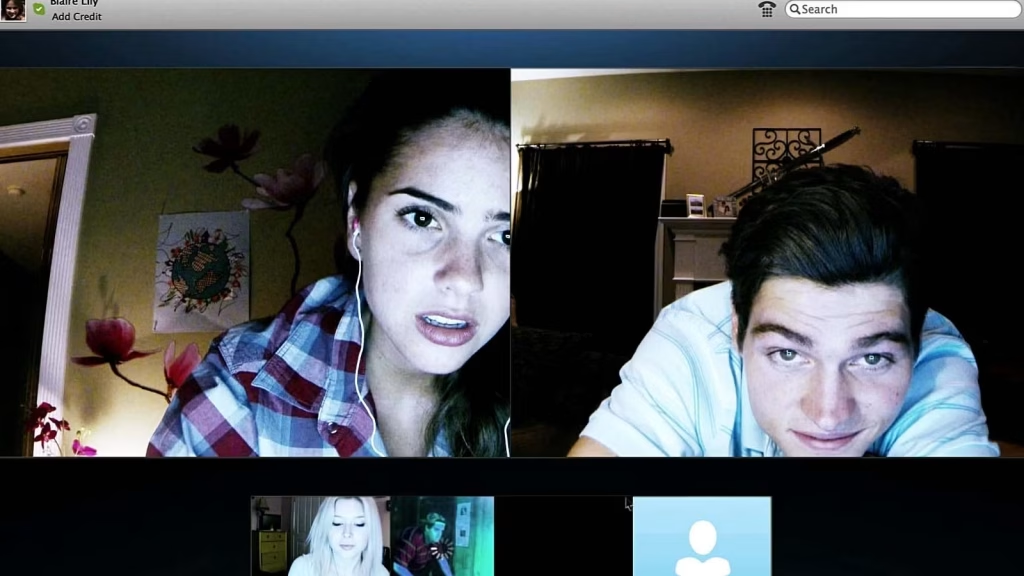
A late-night group video chat unfolds in the dim glow of laptop screens, filled with overlapping chatter, half-focused attention, and the familiar comfort of digital distance. When an unfamiliar user joins the call, no one reacts with real concern at first. The presence feels like a technical hiccup, the kind of minor intrusion that usually disappears if ignored long enough. That assumption begins to rot as the stranger responds with unsettling precision, echoing private conversations and moments that should not be accessible to anyone else.
As the chat continues, old wounds resurface through frozen screens, delayed messages, and files that appear without warning. What once passed as casual online cruelty is dragged back into the present, stripped of context and humor. The group is forced to confront the consequences of a humiliating act they believed had ended years earlier. With no way to disconnect or escape, the call becomes a sealed environment where guilt and fear feed off each other in real time.

Spoiler-Free Review
The film wastes no time establishing its most unsettling trick: it makes you watch the way you already live. Cursor movements, typing indicators, and notification sounds replace traditional score cues, turning everyday digital noise into a source of dread. The stillness between responses stretches longer than expected, creating tension not through spectacle, but through anticipation. It feels invasive in a quiet, personal way, as if someone else has gained access to a space that was never meant to be shared.
What makes the format effective is how naturally it captures group behavior under pressure. Conversations overlap, people talk past one another, and awkward silences fill the gaps where honesty should be. The performances lean into that discomfort, never feeling overly scripted or theatrical. Characters hesitate, minimize, and deflect in ways that feel painfully recognizable, especially when accountability starts to feel dangerous.
Rather than building toward a single release of terror, the film relies on momentum. Each revelation tightens the noose, pushing the group further into self-preservation. When violence arrives, it does so abruptly, breaking through the illusion of safety the screen provides. The 71 EncoreCraft Score reflects a horror film that understands fear as something cumulative, created through pressure and proximity rather than shocks alone.
Craft Notes & Background (Non-Spoiler)
- The film was shot in real time over several weeks, with actors performing extended takes on actual laptops.
- Unfriended popularized the “screenlife” horror format, later used in films like Searching and Host.
- The original working title was Cybernatural.
- Many on-screen actions were performed live rather than added in post-production.
- The film was produced by Timur Bekmambetov, who later expanded the format into multiple projects.
⚠️ ⚠️ SPOILERS BELOW ⚠️ ⚠️
The rest of this review discusses the full plot and ending.
⚠️ ⚠️ SPOILERS BELOW ⚠️ ⚠️
Full Plot Recap (Spoilers)
As the call progresses, the unknown presence reveals itself as the spirit of Laura Barns, a classmate who died by suicide after a humiliating video of her went viral. The group is forced to watch as old messages, photos, and clips resurface on their screens, removing any doubt about her identity. Attempts to leave the call fail, with laptops freezing and accounts hijacked, locking everyone into the same digital space. Panic sets in as the realization sinks in that the past is no longer contained.
One by one, Laura’s spirit targets the group, tailoring each punishment to their individual involvement in her humiliation. Accusations escalate quickly, webcams shut off without explanation, and alliances fracture under the weight of fear. Each character attempts to rewrite their role, shifting blame and minimizing responsibility as the threat becomes more immediate. The haunting feels methodical, less interested in chaos than in forced acknowledgment.
Deaths occur suddenly, often just outside the frame, reinforcing how little control the characters truly have. Confession offers no relief, only further exposure. By the end, Blaire is left alone, her screen illuminating a face stripped of denial. When the spirit finally turns on her, the film closes on an image of isolation that mirrors the cruelty that started everything, delivered through the same digital interface that once made it feel harmless.
Spoiler Analysis
Fear in Unfriended does not manifest as hysteria right away. It appears first in hesitation, in muted microphones and delayed responses, in the instinct to protect oneself before protecting others. As danger escalates, moral clarity collapses quickly. Characters who once laughed along with cruelty now scramble to distance themselves from it, revealing how easily silence becomes complicity when survival feels at stake.
Formally, the film weaponizes limitation. The static frame of the desktop denies the audience relief, forcing attention onto small changes: a cursor moving when it should not, a message sent without explanation, a webcam light flicking on unexpectedly. Horror emerges through interruption rather than spectacle. The screen becomes both barrier and conduit, reminding the viewer that distance does not equal safety.
The ending seals the film’s meaning without offering comfort. Blaire’s isolation reframes the story as a closed loop, where harm committed online never truly disappears. There is no redemption arc, no lesson learned in time to matter. Instead, the film argues that digital cruelty leaves permanent residue, archived and waiting. The true horror is not the ghost on the screen, but the certainty that nothing done online is ever fully erased.
Hidden Craft & Story Secrets (Spoilers)
- The order of character deaths mirrors the severity of each person’s involvement in Laura’s humiliation.
- Several background tabs briefly display hidden messages from the spirit before they are acknowledged by the characters.
- The film’s final jump scare was added late in post-production at the studio’s request.