Zombieland (2009)
A blood-soaked road trip that turns zombie survival into a punchline without losing its bite.

At a Glance
- Director: Ruben Fleischer
- Cast: Jesse Eisenberg, Woody Harrelson, Emma Stone, Abigail Breslin, Bill Murray
- Subgenres: Zombie Horror, Comedy Horror, Survival Horror
- Tone & Style: Fast-Paced, Irreverent, Violent, Character-Driven
- Best For: Viewers who enjoy zombie carnage balanced with sharp humor and memorable character dynamics.
- Not ideal for: Those looking for bleak, straight-faced horror or deeply dramatic apocalypse stories.
- Country of production: United States
- Language: English
Release Date: October 2, 2009 (U.S. theatrical)
Runtime: 88 minutes
Rating: R for horror violence/gore and language.
Rotten Tomatoes: Critics 89% • Audience 86%
Metacritic: Critics 73 • User 7.8
Letterboxd: 3.5 / 5
EncoreCraft Score: 80 / 100
Where to Watch: View current streaming availability on JustWatch
Official Trailer
EncoreCraft Breakdown (0–10)
- Rewatch Value: 9 / 10
- Scare Factor: 6 / 10
- Performances: 8 / 10
- Violence and Disturbance: 7 / 10
- Pacing: 9 / 10

Synopsis
Columbus survives the apocalypse by narrating every movement, every sound, every potential mistake. In a world where doors creak too loudly and footsteps echo for too long, his rules become a substitute for confidence. They keep him alive, but they also keep him isolated, turning survival into a series of small, controlled retreats. Fear defines his rhythm long before zombies ever do.
That fragile order shatters when he meets Tallahassee, a man who charges headfirst into danger with gunfire, noise, and unapologetic excess. Their forced partnership pushes them through silent highways and looted towns where danger often announces itself too late. The arrival of Wichita and Little Rock complicates everything further, introducing deception as a survival tactic that cuts deeper than claws. What follows is not a quest to save the world, but a test of whether connection can survive when trust is constantly under threat.
Spoiler-Free Review
The opening moments establish Zombieland as a film that treats violence as spectacle without ever pretending it is harmless. Bodies collide with pavement in slow motion, blood splashes across the frame, and the soundtrack dares the audience to laugh at the timing. The humor lands because the danger feels real, immediate, and physical. Every joke is backed by the sound of bones snapping or bullets tearing through flesh.
Jesse Eisenberg grounds the chaos through nervous narration that never quite shuts off. His delivery turns anxiety into momentum, making each survival rule feel like a whispered confession rather than a punchline. The constant internal monologue creates tension not by explaining danger, but by anticipating it, allowing silence to linger just long enough to feel unsafe. Panic becomes a rhythm rather than a reaction.
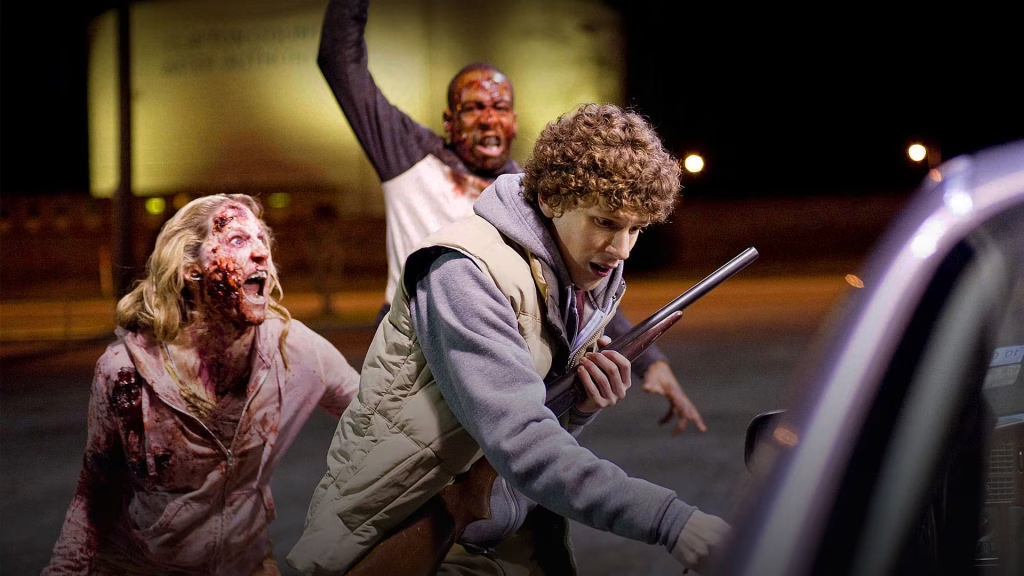
Woody Harrelson’s Tallahassee crashes into scenes like a blunt object, defined by recoil, volume, and forward motion. Shotgun blasts rattle windows, and his physical presence gives the action weight that contrasts sharply with Columbus’s overthinking. Their dynamic transforms routine zombie encounters into clashes of instinct versus restraint. The film finds its sharpest humor in watching those approaches collide under pressure.
What gives Zombieland its staying power is its refusal to let comedy erase consequence. Quiet moments still hum with threat, and safety never feels permanent. Laughter exists alongside danger, not in place of it. Its 80 EncoreCraft Score reflects a film that understands how to balance momentum, violence, and character without letting any one element flatten the others.
Craft Notes & Background (Non-Spoiler)
- The film was directed by Ruben Fleischer, marking his feature directorial debut.
- Zombieland was written by Rhett Reese and Paul Wernick, later known for the Deadpool films.
- Many of the zombie kills were enhanced with stylized slow motion rather than prolonged gore shots.
- The movie was shot primarily in Georgia, standing in for a post-apocalyptic United States.
- The rules graphics were added in post-production to heighten the comic-book tone.
⚠️ ⚠️ SPOILERS BELOW ⚠️ ⚠️
The rest of this review discusses the full plot and ending.
⚠️ ⚠️ SPOILERS BELOW ⚠️ ⚠️
Full Plot Recap (Spoilers)
Columbus survives the initial outbreak by retreating inward, using narration and rules to create distance between himself and the collapsing world. His careful avoidance keeps him alive, but it also keeps him alone, moving through empty spaces where silence feels as dangerous as noise. When he meets Tallahassee, survival becomes louder and less controlled, driven by instinct rather than calculation. Their partnership forms out of necessity, not trust, each man measuring the other through action.
Wichita and Little Rock enter the story through carefully staged betrayals that leave Columbus and Tallahassee exposed in open streets and abandoned buildings. Each con forces the group into closer proximity with danger, where hesitation can be fatal and anger offers no protection. Trust erodes quickly, replaced by wary cooperation shaped by shared risk. Survival becomes less about planning and more about reacting together in the moment.
The detour to an untouched mansion offers the illusion of escape, flooded with bright lights, loud music, and excess. For a brief moment, the apocalypse feels distant, almost unreal. That fantasy collapses when the noise attracts a massive horde, turning luxury into a trap. Hallways become choke points, gunfire echoes through open rooms, and survival hinges on movement rather than control.
In the climax, Columbus abandons strict self-preservation and charges back into danger to help the others. His choice marks a shift from avoiding fear to acting through it, even when the outcome is uncertain. The group survives not because they are smarter or stronger, but because they act together. The film ends with them moving forward as a unit, bruised and exhausted, but no longer alone.
Spoiler Analysis
Fear in Zombieland degrades decision-making by narrowing perspective. Columbus begins by minimizing risk through avoidance, but that strategy collapses the moment other people enter the equation. Each rule that once protected him becomes harder to follow when emotional stakes rise. Fear does not disappear when he breaks those rules; it simply changes shape, becoming something that must be managed through action rather than retreat.
Formally, the film weaponizes contrast to generate tension. Loud gunfire follows long stretches of silence, while slow-motion violence interrupts still frames of empty space. Comedy arrives through timing rather than relief, landing precisely when danger peaks instead of after it passes. This structure keeps the audience alert, never allowing humor to fully disarm the threat.
The ending reframes survival as a shared condition rather than an individual achievement. Connection does not make the world safer, but it makes it survivable. The group’s forward motion suggests endurance rather than hope, grounded in the understanding that isolation offers no protection. Zombieland closes by arguing that laughter, like violence, is simply another response to fear, one that only works when someone else is there to hear it.
Hidden Craft & Story Secrets (Spoilers)
- Bill Murray’s cameo was kept secret during production and written specifically for him.
- The mansion finale required extensive night shooting to maintain consistent lighting during action sequences.
- Several zombie performers were trained stunt actors to allow for close-quarters combat scenes.