Halloween III: Season of the Witch (1982)
A bitterly strange franchise detour that trades masked slashers for corporate occultism, bleak paranoia, and one of horror’s cruelest final punches.

At a Glance
- Director: Tommy Lee Wallace
- Cast: Tom Atkins, Stacey Nelkin, Dan O’Herlihy
- Subgenres: Sci-Fi Horror, Occult Horror, Mystery-Horror Hybrid
- Tone & Style: Bleak, Atmospheric, Cold, Paranoid, Concept-Driven
- Best For: Horror fans curious about unconventional franchise entries and grim, idea-driven 1980s genre films.
- Not ideal for: Viewers expecting a Michael Myers slasher or a crowd-pleasing Halloween comfort watch.
- Country of production: United States
- Language: English
Release Date: October 22, 1982 (U.S. theatrical)
Runtime: 98 minutes
Rating: R for violence and gore, language, and brief nudity.
Rotten Tomatoes: Critics 48% • Audience 31%
Metacritic: Critics 50 • User 6.2
Letterboxd: 2.8 / 5
EncoreCraft Score: 62 / 100
Where to Watch: View current streaming availability on JustWatch
Official Trailer
EncoreCraft Breakdown (0–10)
- Rewatch Value: 7 / 10
- Scare Factor: 6 / 10
- Performances: 7 / 10
- Violence and Disturbance: 6 / 10
- Pacing: 7 / 10

Synopsis
A man staggers into a California hospital clutching a Halloween mask, his breath shallow and his eyes fixed in panic, before collapsing and dying under suspicious circumstances. That brief, violent moment pulls disgraced physician Dan Challis into an investigation he clearly wants no part of, but cannot ignore. The mask itself feels wrong, its cheap rubber surface lingering in the room long after it has been removed. Rather than follow procedure, Challis follows discomfort, letting unease guide him where evidence refuses to cooperate.
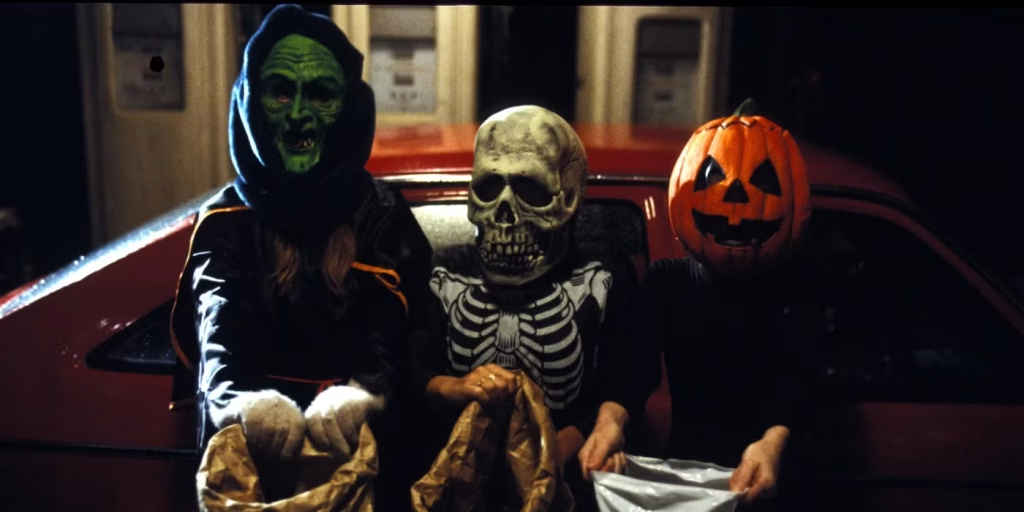
That trail leads him to Santa Mira, a town that feels assembled rather than grown. At its center sits Silver Shamrock Novelties, a toy company flooding the airwaves with brightly colored masks and an inescapable jingle that blares from televisions at all hours. The streets are clean, the smiles fixed, and the workers strangely uniform in their behavior. As Halloween night approaches, the town’s artificial cheer begins to suffocate, hinting at a system designed not for celebration, but for control.
Spoiler-Free Review
Halloween III rejects familiarity almost immediately, replacing the comfort of repetition with a creeping sense of intrusion. The film moves through hospitals, motels, and factory floors filled with buzzing fluorescent lights and humming machines, spaces that feel monitored rather than occupied. Televisions flicker in the background of nearly every scene, their glow suggesting an unseen presence always watching. Instead of building toward release, the tension settles in and refuses to leave.
Tom Atkins grounds the film through exhaustion rather than bravado. His Dan Challis slouches through the story with bloodshot eyes, jittery hands, and a permanent edge of irritation that feels painfully human. He reacts to danger with annoyance and disbelief before fear ever sets in, as though the situation itself is an insult. That physical weariness keeps the film from drifting into camp, anchoring its stranger ideas in a body that already feels spent.
Atmosphere is the film’s sharpest weapon. The Silver Shamrock jingle repeats with mechanical precision, burrowing into the ear until it becomes inseparable from dread. Santa Mira’s spotless interiors and symmetrical streets feel less safe than decay ever could. Director Tommy Lee Wallace drains warmth from every frame, turning order, branding, and routine into instruments of quiet menace.
What ultimately defines Halloween III is its refusal to soften its concept. There is no reassuring pivot, no heroic surge that promises balance will be restored. The film commits to inevitability, allowing dread to build through repetition rather than escalation. Its 62 EncoreCraft Score reflects a film that understands frustration as part of the experience, and wields it with deliberate cruelty.
Craft Notes & Background (Non-Spoiler)
- This film was designed to launch an anthology direction for the Halloween franchise, with each entry telling a standalone story.
- John Carpenter and Debra Hill returned as producers and composers, providing the film’s electronic score.
- Director Tommy Lee Wallace previously worked as production designer and editor on the original Halloween.
- The town of Santa Mira is named after the setting of Invasion of the Body Snatchers.
- Michael Myers appears only briefly on a television screen as a fictional movie character.
⚠️ ⚠️ SPOILERS BELOW ⚠️ ⚠️
The rest of this review discusses the full plot and ending.
⚠️ ⚠️ SPOILERS BELOW ⚠️ ⚠️
Full Plot Recap (Spoilers)
Dan Challis traces the dead mask salesman’s movements to Santa Mira, where every road seems to loop back toward Silver Shamrock Novelties. The town operates like a sealed environment, its residents largely factory workers who follow rigid routines and ask no questions. At the center of it all is Conal Cochran, Silver Shamrock’s founder, whose warmth feels rehearsed and whose politeness masks absolute authority. He welcomes Challis with tours and explanations that feel less informative than performative, carefully controlling what is seen and when.
As Challis digs deeper, the town’s artificial calm begins to fracture. Locked doors, silent watchers, and eerily uniform workers make it clear that curiosity is neither welcomed nor tolerated. Cochran eventually reveals the truth with unsettling pride. The masks contain fragments of Stonehenge, fused with modern circuitry to bind ancient ritual to contemporary technology. A hidden signal embedded in the company’s omnipresent jingle is designed to activate the masks on Halloween night.
When the signal is triggered, the consequences are immediate and grotesque. Children wearing the masks collapse as insects and reptiles pour from shattered plastic, while nearby adults watch in helpless shock. Challis destroys the factory in a desperate attempt to stop the operation, fire and sparks tearing through Santa Mira’s carefully maintained order. But the broadcast has already escaped the town.
The film ends without relief or certainty. Challis frantically calls television stations, his voice cracking as he begs them to pull the commercial before it is too late. Some comply, others hesitate, and time slips away unanswered. His final scream echoes into silence, leaving the scope of the catastrophe unresolved and unbearable.
Spoiler Analysis
Halloween III treats fear as an erosive force rather than a catalyst for heroism. As pressure mounts, Challis becomes reactive, abandoning planning in favor of frantic motion. His choices grow smaller, more desperate, and increasingly improvised, reflecting how fear narrows perception rather than sharpening it. The film suggests that panic does not inspire clarity, but accelerates collapse.
Formally, the film’s horror emerges from systems functioning exactly as intended. Cochran never shouts or lunges; he supervises. Assembly lines hum, broadcasts air on schedule, and rituals unfold with corporate efficiency. Violence arrives not through chaos, but through flawless execution. By presenting atrocity as routine, the film makes its threat feel disturbingly plausible.
The ending reframes the entire story as a lesson in scale. By cutting to black mid-scream, the film denies the audience any image capable of containing the damage. What lingers instead are glowing television screens and plastic masks already in motion. Halloween III argues that once harm is distributed through media and commerce, stopping it becomes a matter of chance rather than courage, and chance is rarely kind.
Hidden Craft & Story Secrets (Spoilers)
- The final phone-call ending was intentionally left ambiguous to deny the audience closure.
- Cochran’s factory workers are implied to be androids, though the film never fully explains their origins.