Queen of the Damned (2002)
A glossy, mournful vampire opera that trades gothic intimacy for early-2000s excess, ambition, and tragedy.

At a Glance
- Director: Michael Rymer
- Cast: Stuart Townsend, Aaliyah, Marguerite Moreau, Vincent Perez, Paul McGann, Lena Olin
- Subgenres: Vampire Horror, Supernatural Horror, Fantasy Horror
- Tone & Style: Gothic, Stylized, Music-Driven, Operatic, Melancholic
- Best For: Viewers drawn to vampire mythology filtered through early-2000s goth culture and rock-infused spectacle.
- Not ideal for: Those seeking restrained gothic horror or a faithful, character-driven Anne Rice adaptation.
- Country of production: United States
- Language: English
Release Date: February 22, 2002 (U.S. theatrical)
Runtime: 101 minutes
Rating: R for strong violence, sexuality/nudity and language.
Rotten Tomatoes: Critics 17% • Audience 66%
Metacritic: Critics 30 • User 5.7
Letterboxd: 2.8 / 5
EncoreCraft Score: 58 / 100
Where to Watch: View current streaming availability on JustWatch
EncoreCraft Breakdown (0–10)
- Rewatch Value: 6 / 10
- Scare Factor: 4 / 10
- Performances: 6 / 10
- Violence and Disturbance: 5 / 10
- Pacing: 5 / 10
Synopsis
Noise is the first thing Lestat embraces after centuries of sleep. Stage lights flare, amplifiers howl, and his return to the world is announced through volume rather than secrecy. By recasting himself as a rock star, he turns immortality into spectacle, forcing vampires who survived by hiding to confront a new kind of exposure. Every performance draws humans closer while sending quiet warnings through ancient bloodlines that something reckless has begun.
Akasha’s awakening shifts the air of the story almost immediately. Where Lestat moves in motion and sound, she arrives in stillness, her presence heavy enough to drain rooms of momentum. She claims him not as a partner, but as a symbol, blending desire and domination into a single, suffocating bond. As humanity and immortals alike are pulled toward her vision, Lestat finds himself caught between the thrill of visibility and the terror of becoming something irreversible.

Spoiler-Free Review
The opening concert feels less like an introduction and more like an invasion. Bodies surge beneath strobes, guitars grind against the mix, and the camera treats Lestat as an icon rather than a person. Story takes a back seat to sensation, and that imbalance defines much of the film’s identity. It is loud, seductive, and restless, chasing atmosphere with the confidence of something that knows exactly how it wants to feel.
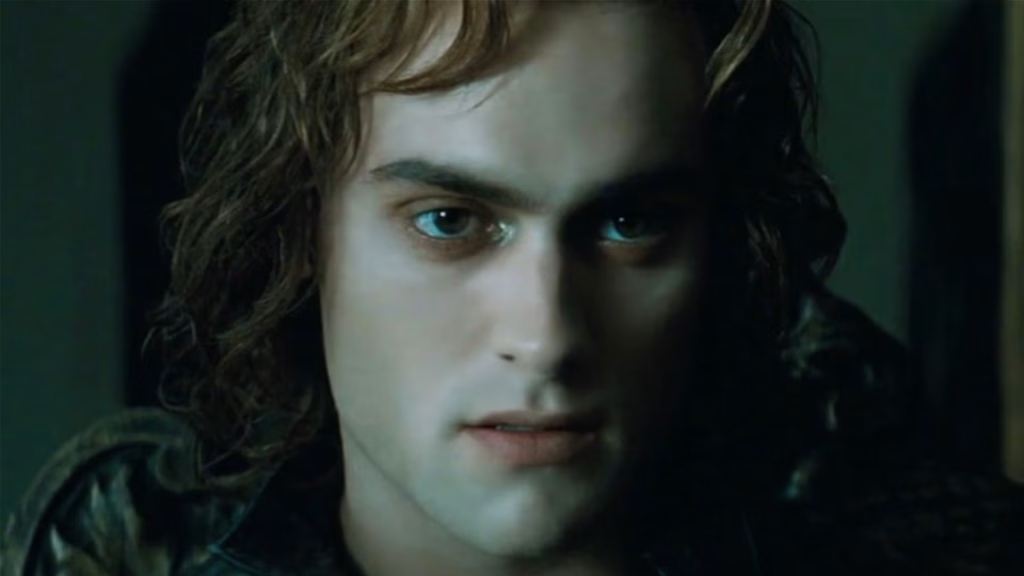
Stuart Townsend’s performance leans into that outward energy. His Lestat is driven by impulse and ego, always moving, always searching for the next reaction. Intimacy gives way to posture, but that choice aligns with the film’s obsession with visibility. Lestat is rarely alone in frame, even when the character feels isolated, swallowed by lights, crowds, and expectation.
Aaliyah’s Akasha operates on the opposite frequency. She moves slowly through modern spaces, her control defined by restraint rather than force. Scenes quiet when she enters, and her calm becomes unsettling precisely because it resists the film’s excess. The contrast between her ancient composure and the surrounding chaos generates the film’s strongest tension, even when the script struggles to deepen her interior life.
Tonal friction remains the film’s defining flaw and fascination. Whispered mythology collides with nu-metal aggression, and transitions often feel abrupt rather than deliberate. Dialogue sometimes exists only to push the film toward its next image, leaving emotional beats underdeveloped. Still, beneath the excess lies a sincere sadness, framing immortality not as liberation but as exhaustion stretched across centuries. The 58 EncoreCraft Score reflects a film that falters as horror, yet endures as a striking cultural artifact.
Craft Notes & Background (Non-Spoiler)
- The film is loosely based on Anne Rice’s novels The Vampire Lestat and The Queen of the Damned.
- Aaliyah’s role as Akasha was completed shortly before her death in 2001.
- The soundtrack features performances by bands such as Korn, Disturbed, and Deftones.
- Jonathan Davis of Korn provided Lestat’s singing voice.
- Director Michael Rymer also directed episodes of Battlestar Galactica.
⚠️ ⚠️ SPOILERS BELOW ⚠️ ⚠️
The rest of this review discusses the full plot and ending.
⚠️ ⚠️ SPOILERS BELOW ⚠️ ⚠️
Full Plot Recap (Spoilers)
Warnings arrive early and are ignored just as quickly. Marius confronts Lestat in dim rooms lit by candles and memory, insisting that visibility invites disaster. Lestat listens, then steps back onto the stage, drawn toward louder crowds and larger rooms. Each performance pushes the vampire world closer to awakening something it has worked for centuries to suppress.
That awakening comes through Akasha. Her emergence shifts the film from rebellion to inevitability, her gaze fixing on Lestat with predatory certainty. She travels with him through cities and ruins alike, silencing opposition with effortless violence. Her plan is absolute: humanity must be reduced so vampires can rule openly, and Lestat is meant to be the face of that new order.
Resistance forms slowly, fractured by fear and mistrust. The covens gather in darkness, bound less by unity than desperation. Through Jesse, ancient blood magic passes from body to body, turning individual voices into a shared weapon. Akasha’s power begins to fracture not through combat, but through connection she refuses to acknowledge.
The confrontation ends without triumph. Akasha disintegrates under the spell, her certainty collapsing as her body breaks apart. Lestat survives by stepping away from the role designed for him, rejecting godhood without claiming redemption. In the aftermath, he withdraws from the spotlight, leaving behind only echoes of what visibility nearly cost him.
Spoiler Analysis
Akasha’s behavior under pressure reveals fear as rigidity rather than panic. Faced with resistance, she responds by tightening control, eliminating dissent with swift, impersonal violence. Rooms fall silent when she enters, bodies drop without struggle, and certainty replaces adaptability. The film frames her downfall as the natural result of authority that refuses to bend.
The film’s scare mechanism relies on exposure instead of suspense. Sound overwhelms silence, crowds replace shadows, and danger emerges from being seen too clearly. Lestat is not stalked so much as consumed, trapped beneath lights that never dim. Horror surfaces through scale, through the suffocating idea that immortality leaves no space to retreat.
The ending offers withdrawal rather than resolution. Lestat’s retreat from fame feels less like growth and more like survival instinct asserting itself. Immortality remains, stripped of illusion and spectacle, reduced to endurance. The film closes on absence, suggesting that eternal life offers no culmination, only repetition, and that meaning erodes fastest when everything is illuminated.
Hidden Craft & Story Secrets (Spoilers)
- Anne Rice publicly distanced herself from the adaptation after its release.
- Several scenes were reportedly reedited to emphasize Akasha following test screenings.